Key Takeaways
Carrier-grade APIs deliver the reliability, scalability, and integration capabilities that modern unified communications demand.
The telecom API market is projected to exceed $800 billion by 2030, driven by enterprises seeking programmable communication infrastructure.
True carrier-grade solutions require 99.999% uptime ("five nines"), translating to only five minutes of annual downtime.
API-first architectures eliminate vendor lock-in while enabling rapid integration with existing business systems.
Developer-centric platforms with robust documentation and RESTful APIs accelerate time-to-production for voice, messaging, and video applications.
For organizations building mission-critical communication systems, choosing a carrier-grade API provider determines whether your infrastructure survives network disruptions or collapses under pressure.
Organizations now require unified platforms that seamlessly integrate voice, video, messaging, and collaboration tools across distributed workforces and global customer bases. At the foundation of this transformation sits a critical technology layer that determines success or failure: the carrier-grade API.
The global telecom API market reached $251 billion in 2024 and is accelerating toward $827 billion by 2030. This growth reflects a shift in how enterprises approach communication infrastructure. Rather than deploying hardware-heavy systems that require months of implementation, development teams now embed sophisticated voice and messaging capabilities through programmable interfaces that connect directly to carrier networks.
What Makes a Carrier-Grade API Different from Standard Solutions?
The term "carrier-grade" carries a specific meaning in telecommunications. It describes infrastructure built to meet the rigorous standards of network operators who can't afford failures. When applied to APIs, this translates into measurable commitments around availability, performance, and reliability that standard solutions can't match.
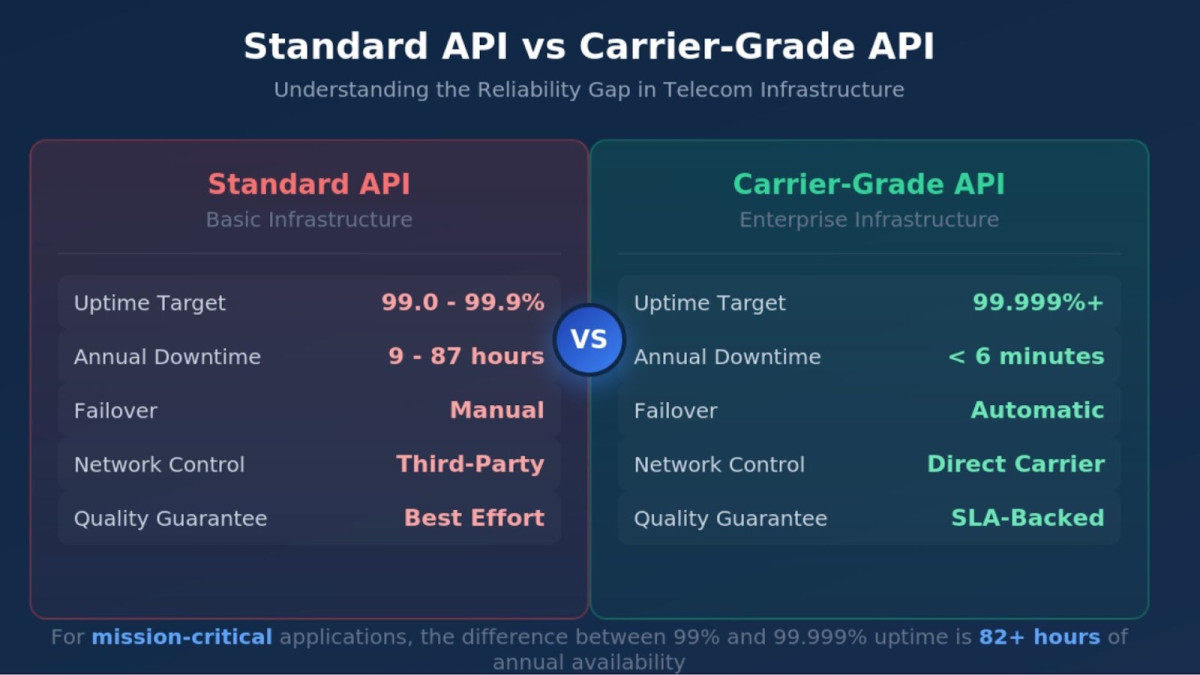
A reliable telecom API built on carrier-grade infrastructure must achieve 99.999% uptime. This "five nines" standard means approximately five minutes of total downtime per year. For context, 99.9% uptime allows nearly nine hours of annual downtime, while 99% permits over 87 hours. The difference becomes critical for healthcare providers managing patient calls, financial institutions processing time-sensitive transactions, or contact centers where every dropped call represents lost revenue.
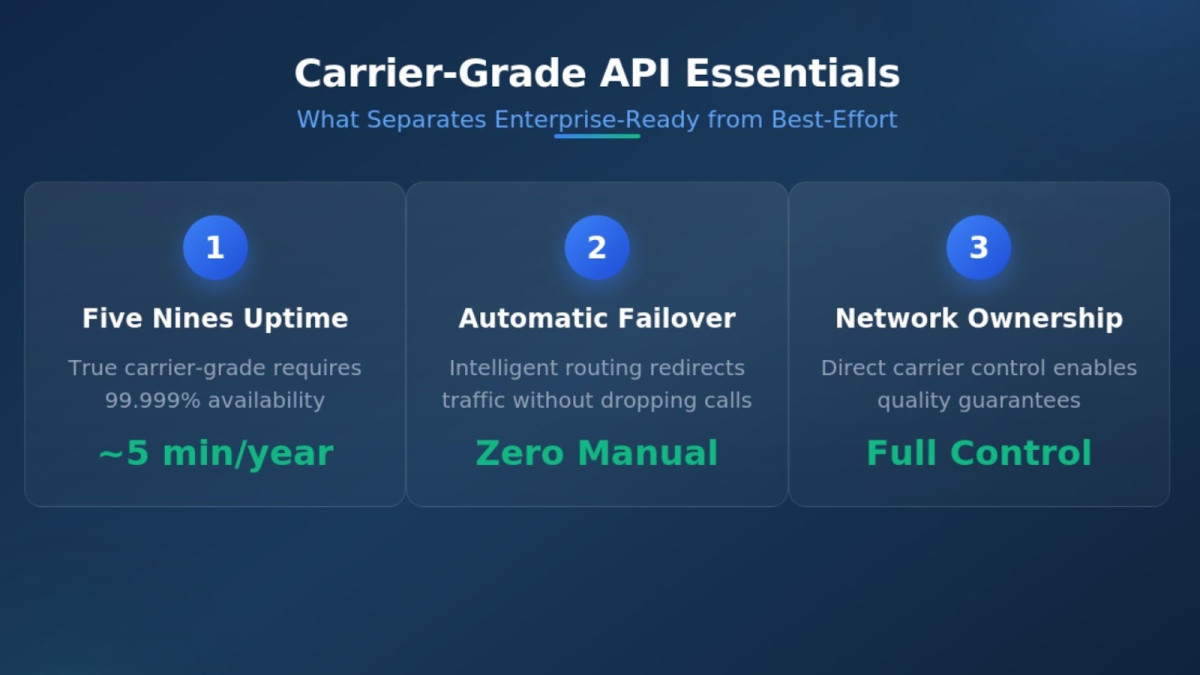
Beyond uptime guarantees, carrier-grade solutions incorporate fault tolerance through redundant systems, automatic failover routing, and geographically distributed infrastructure. When one network path experiences degradation, intelligent routing shifts traffic to healthy alternatives without dropping active sessions. This architectural approach treats network failures as inevitable events to be managed rather than catastrophic exceptions.
Standard vs. Carrier-Grade API Characteristics | Standard API | Carrier-Grade API |
Target Uptime | 99.0% – 99.9% | 99.999%+ |
Annual Downtime Allowed | 9 – 87 hours | Less than 6 minutes |
Failover Mechanism | Manual or basic | Automatic, intelligent routing |
Network Ownership | Third-party dependent | Direct carrier relationships |
Voice Quality Guarantee | Best effort | SLA-backed quality metrics |
Security Standards | Basic encryption | End-to-end encryption with compliance |
How Does VoIP Infrastructure Support Unified Communications?
Modern VoIP infrastructure is the backbone for unified communications platforms. It converts traditional voice signals into data packets transmitted over IP networks, enabling integration with digital workflows, CRM systems, and collaboration tools. The quality of this infrastructure directly impacts call clarity, connection reliability, and the ability to scale during peak demand periods.
Enterprise-grade VoIP infrastructure requires careful attention to Quality of Service (QoS) mechanisms that prioritize voice traffic over other data. Without proper QoS implementation, voice packets compete with email downloads and file transfers, resulting in jitter, latency, and dropped syllables that frustrate users and undermine professional interactions. Carrier API providers with their own network infrastructure can enforce QoS at the network level rather than relying on best-effort routing through third-party paths.
The Role of SIP Trunking in API-Driven Communications
Session Initiation Protocol (SIP) trunking connects VoIP systems to the public switched telephone network (PSTN), enabling calls between internet-connected endpoints and traditional phone lines. When delivered through programmable voice APIs, SIP trunking becomes a developer-friendly building block rather than a complex infrastructure project.
RESTful APIs have become the standard architecture for modern SIP integrations. They use familiar HTTP methods and JSON formatting, allowing developers to work with telephony resources using the same patterns they apply to other web services. This architectural choice reduces the learning curve and accelerates integration timelines.
What Should Developers Evaluate When Selecting Carrier API Providers?
Choosing the right provider requires evaluating multiple dimensions beyond feature lists. The following criteria distinguish robust carrier-grade platforms from solutions that will create problems as applications scale.
Network Ownership and Control
Providers who own their network infrastructure maintain direct control over routing decisions, quality monitoring, and failover mechanisms. Those who aggregate services through third-party carriers inherit the limitations and outage risks of their upstream providers. Direct carrier relationships enable faster troubleshooting and more granular control over call routing when issues arise.
Developer Experience and Documentation
A carrier-grade API means nothing if developers can't implement it efficiently. Comprehensive documentation, quickstart guides, SDKs in multiple programming languages, and responsive developer support determine whether integration takes days or months. Look for providers offering sandbox environments where teams can test implementations without impacting production traffic or incurring usage charges.
Transparent Pricing and Scalability
Metered usage pricing allows organizations to pay for actual consumption rather than provisioning capacity for peak demand. This model supports both testing phases with minimal traffic and production deployments handling millions of messages or call minutes. Avoid providers requiring long-term commitments or minimum usage thresholds that create friction during scaling.
Why Are Reliable Telecom APIs Essential for Mission-Critical Applications?
Certain applications can't tolerate communication failures. Healthcare providers depend on mission-critical voice systems for patient care coordination and emergency response. Financial services firms require reliable channels for transaction confirmations and fraud alerts. Contact centers generate revenue through every successfully completed call.
For these use cases, the consequences of unreliable infrastructure extend beyond inconvenience. Missed calls can lead to compliance violations, patient safety incidents, or revenue losses measured in thousands of dollars per minute. Reliable telecom APIs backed by carrier-grade infrastructure provide the foundation these applications require.
Business Continuity Through Intelligent Failover
True carrier-grade platforms implement failover at multiple layers. When a local network experiences issues, calls automatically route through alternate paths. When an entire geographic region faces disruption, traffic shifts to redundant data centers in other locations. This approach ensures incoming calls reach their destination even when individual network components fail.
Some advanced platforms continuously monitor network conditions and proactively reroute traffic before degradation impacts call quality. This predictive approach minimizes disruption rather than simply reacting to failures after they occur.

What Are Five Essential Features of Enterprise-Ready Carrier-Grade APIs?
Organizations evaluating carrier API providers should prioritize platforms offering these capabilities:
Automatic failover routing that detects network issues and redirects traffic without dropping active sessions
Geographic redundancy with data centers in multiple regions providing isolation from localized outages
Real-time monitoring and alerting enabling proactive response to quality degradation before users notice problems
Comprehensive fraud protection, including toll fraud detection, destination whitelisting, and rate limiting
Full-featured web portals allowing administrators to manage numbers, routes, and settings without developer involvement
API Evaluation Criteria | Questions to Ask |
Reliability | What is the SLA-backed uptime commitment? |
Failover | Does automatic rerouting occur at the network level? |
Documentation | Are SDKs available in my preferred programming languages? |
Support | Can I reach engineers during implementation, not just sales? |
Pricing | Is billing metered without minimum commitments? |
Security | What encryption and fraud protection mechanisms exist? |
How CPaaS Platforms Leverage Carrier-Grade Infrastructure
Communications Platform as a Service (CPaaS) solutions deliver programmable voice, messaging, and video through cloud-based APIs. Industry analysts project that 90% of global enterprises will leverage CPaaS for customer engagement by 2028.
The most effective CPaaS providers distinguish themselves through the quality of their underlying infrastructure rather than the breadth of their feature sets. A platform offering every imaginable capability provides little value if calls drop during peak traffic or messages fail to deliver.
Developers building on CPaaS platforms should probe beyond marketing materials to understand the infrastructure supporting advertised features. Questions about network ownership, redundancy architecture, and historical uptime performance reveal whether a provider can deliver carrier-grade reliability or merely claims it.
FAQ
What does "carrier-grade" mean for telecom APIs? Carrier-grade refers to infrastructure meeting telecom industry standards for availability, reliability, and performance. Specifically, it requires 99.999% uptime (approximately five minutes of annual downtime), fault-tolerant architecture with automatic failover, and quality of service guarantees for voice and messaging traffic.
Why should developers choose carrier API providers over standard CPaaS platforms? Carrier API providers typically own their network infrastructure, enabling direct control over routing, quality monitoring, and failover mechanisms. Standard platforms aggregating services through third parties inherit upstream limitations and can't guarantee the same level of reliability for mission-critical applications.
How do reliable telecom APIs improve unified communications? Reliable telecom APIs provide the programmatic foundation for integrating voice, messaging, and video into unified platforms. They enable developers to embed communication features directly into business applications while maintaining enterprise-grade quality, security, and scalability requirements.
Build Communications That Never Fail
The transition to API-driven unified communications presents both an opportunity and a risk. Organizations that select robust carrier-grade infrastructure gain advantages through reliable customer connections, efficient developer workflows, and cost-effective scalability. Those who choose inadequately face the consequences when calls drop, messages fail, and communication becomes a liability rather than an asset.
Flowroute delivers carrier-grade SIP trunking and messaging APIs built on its patented HyperNetwork™ technology, providing the reliability developers need and the failover protection enterprises require.