
Alibaba Launches A Large Model Trained Inside a Coding Platform
SINGAPORE, SG / ACCESS Newswire / February 3, 2026 / Alibaba today announced the release of Qwen- Coder-Qoder, a large language model custom-trained end-to-end for an agentic coding platform.
The model is developed and shipped by Qoder, Alibaba's agentic coding platform focused on real software development. From Qoder's initial public launch to a fully customized large model, the team completed the full model-agent-product loop in just five months.
Code-specialized models have existed for years, but most have been trained primarily on static datasets and benchmarks. This approach limits their ability to operate reliably inside real software projects, where codebases are large, engineering rules are project-specific, and workflows extend far beyond single prompts.
Qwen-Coder-Qoder takes a different approach. Instead of being trained mainly on static code corpora, the model is trained inside the live Qoder product itself, using real agent workflows, real repositories, and real software engineering feedback as reinforcement signals. This makes it the first large model designed to operate as an integral part of a coding product, rather than as a standalone coding assistant.
Qoder launched publicly in late August last year with a clear and narrow goal: to build an agentic programming platform that works on real codebases, not toy examples or prompt demos. From the platform launch to the custom model, every step has been driven by the same focus-closing the gap between code generation and real software development, and making large models actually usable for building and maintaining production systems.
Where the Difference Starts
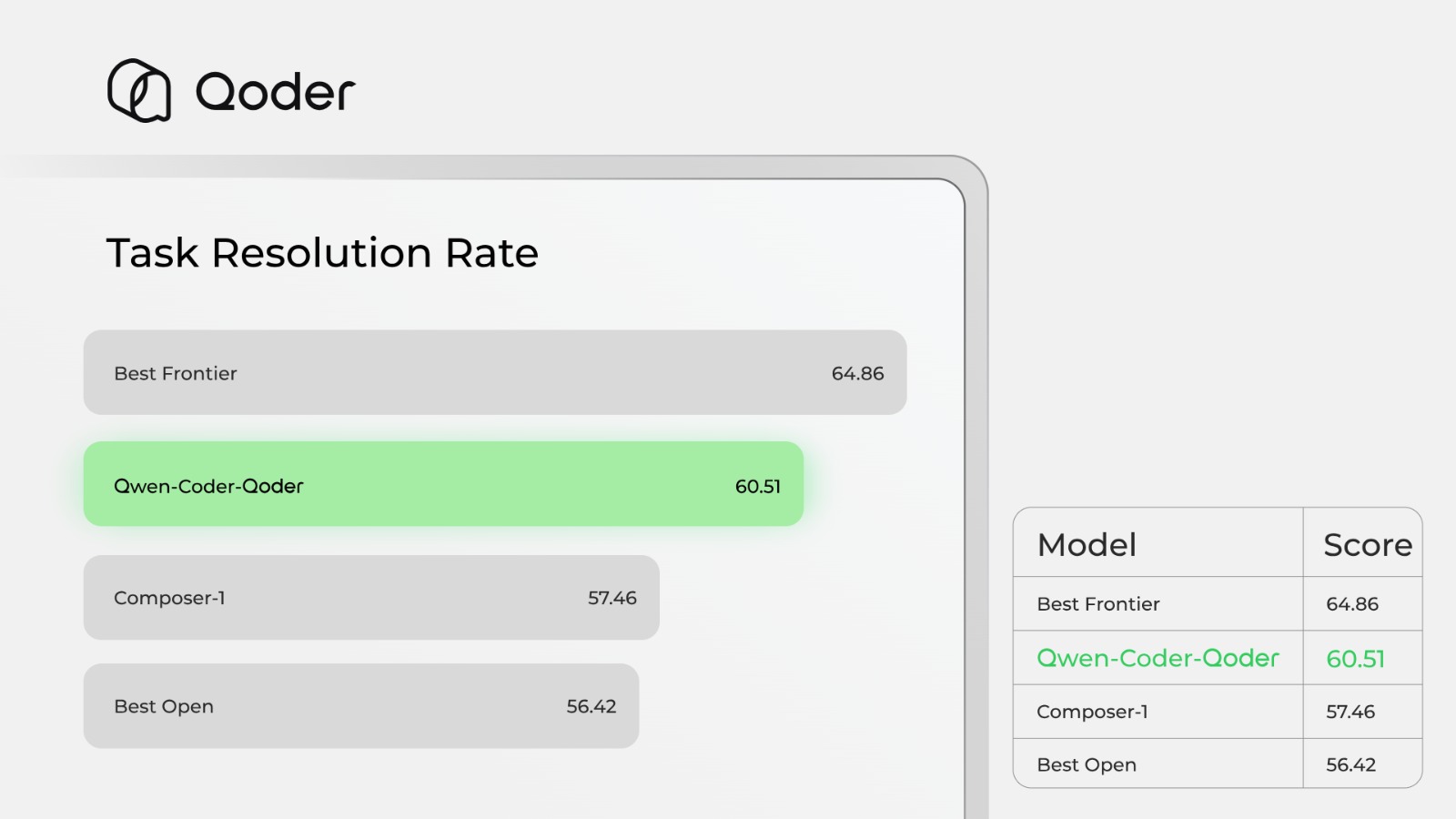
The updated Qoder stack is already running with real users, and the benchmark above reflects a clear design trade-off. Qwen-Coder-Qoder reaches a task resolution rate of 60.51%, coming close to the Best Frontier model (Claude 4.5 Opus) at 64.86%, while outperforming other strong coding systems such as Composer-1(57.46%) and Best Open (56.42%).
Product example image 1
What matters here is not just the absolute score, but the context behind it. Claude represents a general-purpose frontier model optimized for broad reasoning across many domains. Qwen-Coder-Qoder, by contrast, is a model trained inside a production coding platform, optimized specifically for agent-driven software workflows. Despite this narrower focus, it achieves near-frontier task resolution while operating with lower cost and fewer retries.
In live usage, this shows up clearly in system-level metrics. As the model iterated in production, code generation retention increased by 3.85%, tool-related failures dropped by 61.5%, and token usage decreased by 14.5%. These gains reflect improvements not just in output quality, but in how reliably the model executes multi-step development tasks.
More importantly, the difference is behavioral. Qwen-Coder-Qoder follows project-specific engineering rules, reasons over entire repositories using code graphs and project memory, and continues working through difficult problems instead of stopping after a single response. The goal is not faster answers in isolation, but fewer broken workflows when building and maintaining real software.
A Different Way to Build Coding Models
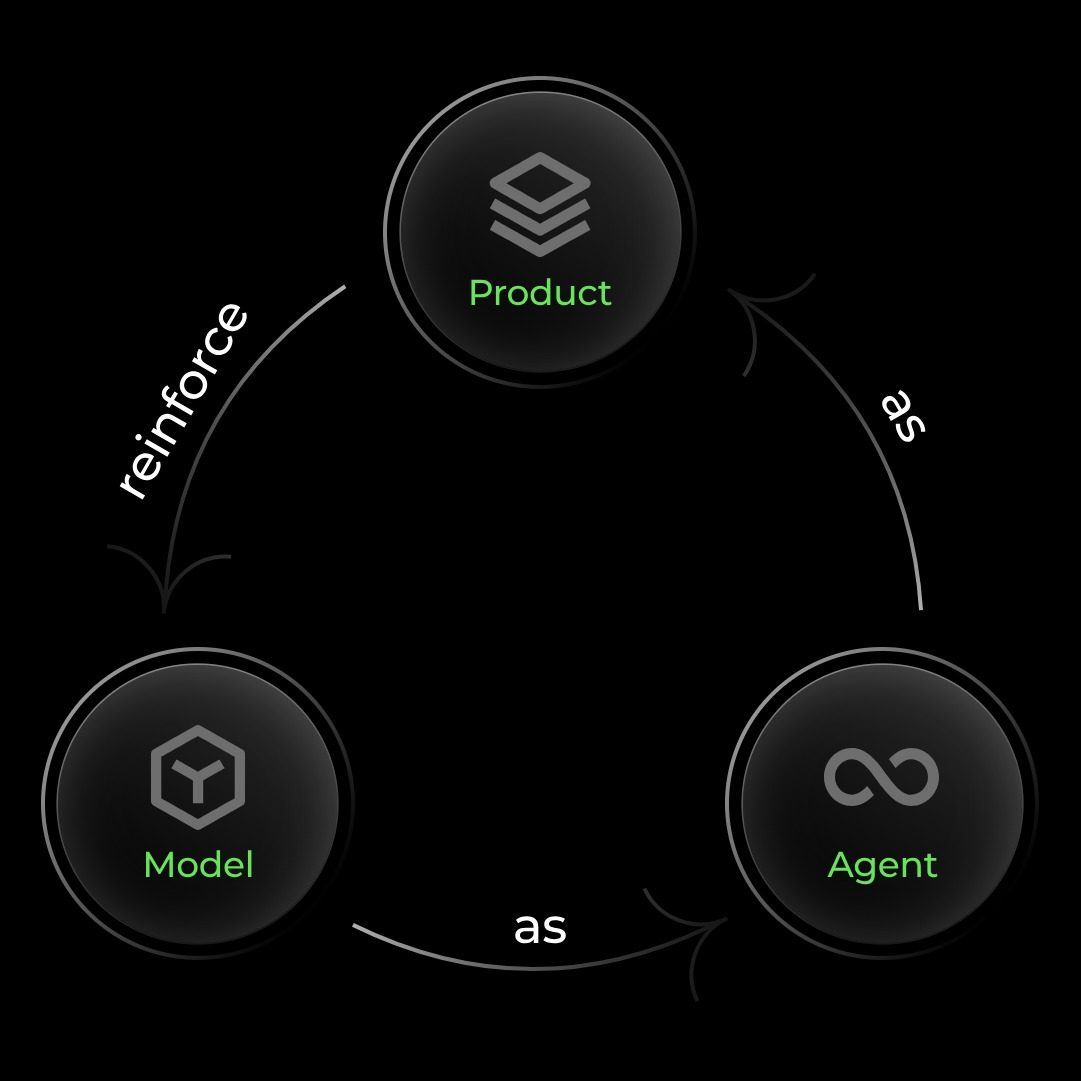
Instead of treating the model as a static backend behind a chat interface, Qoder is built around a tight feedback loop between model, agent, and product. The goal is not better prompts, but better execution inside real software workflows.
Product example image 2
Model as Agent
Core agent capabilities-task planning, engineering constraints, and repository- level reasoning-are trained directly into Qwen-Coder-Qoder. The model is designed to execute multi-step workflows on its own, rather than relying on external orchestration.
Agent as Product
In Qoder, the agent is the product. User-facing features are built around what the agent can plan, execute, and verify across a codebase, not around conversational interaction.
Product Improves the Model
As the product is used in real development scenarios, user behavior and real software engineering decisions are converted into reinforcement signals. These signals feed directly back into training, allowing the model to improve based on how software is actually built and maintained.
Together, this creates a closed-loop system where real software development continuously improves the model.
TrainingInsideReal Software
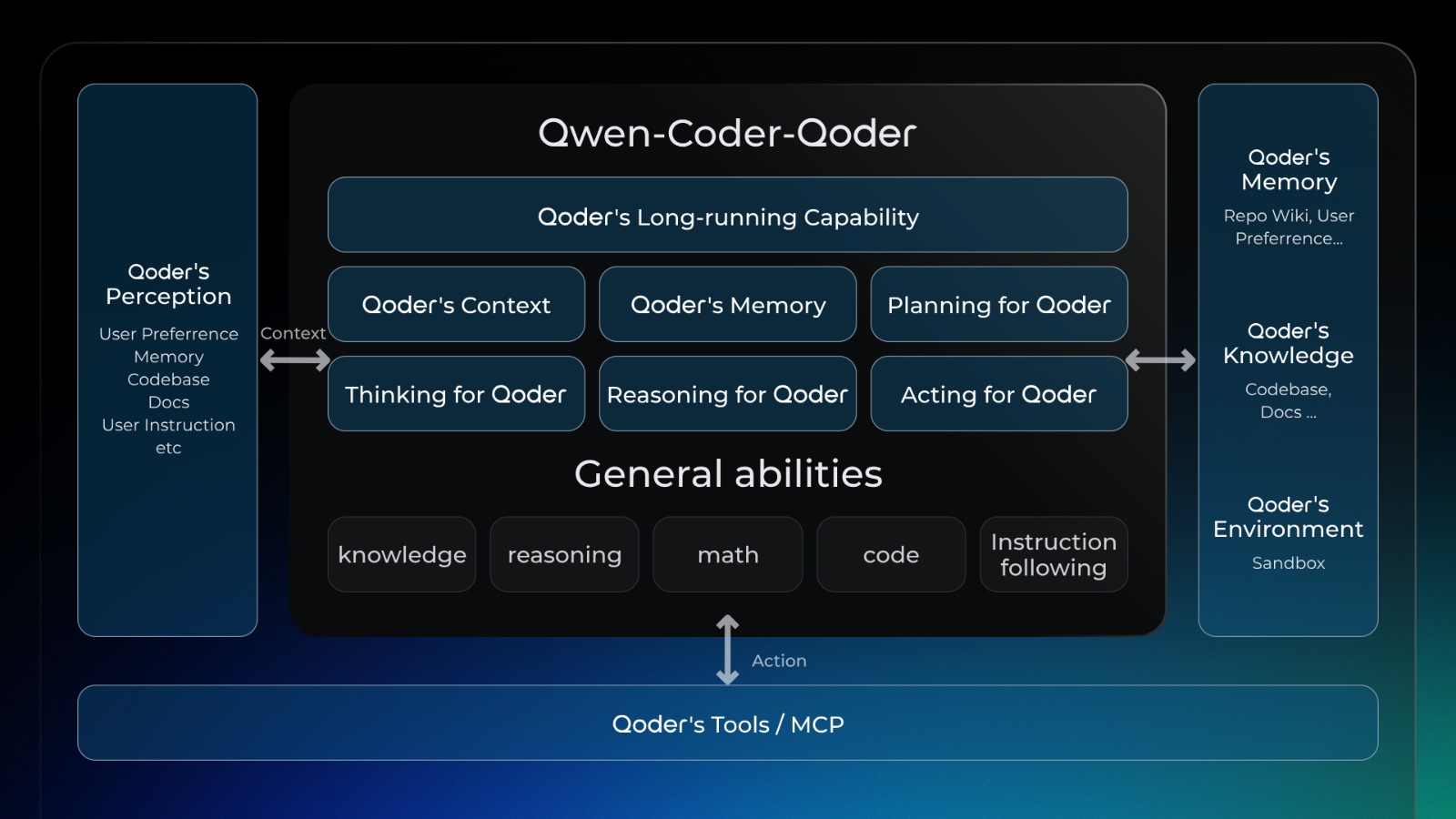
Qwen-Coder-Qoder is trained inside the same Qoder Agent environment used in production, with access to identical Knowledge, Memory, Tools, and MCP components. Training and inference follow the same execution path, reducing the gap between offline optimization and real-world behaviour.
Product example image 3
To make this possible at scale, Qoder built a container-based execution system capable of spinning up and tearing down tens of thousands of runnable project environments. This gives the model exposure to real codebases, real dependencies, and real failure modes, rather than synthetic tasks.
Rewards are derived not only from unit tests and command-line validation, but also from an internal adversarial "Rewarder-Attacker ? system. This setup is designed to reduce reward hacking and enforce stable, production-relevant behavior.
Training is conducted using ROLL Reinforcement Learning on Large-scale Language Models). Through system-level optimizations, thousand-GPU clusters can efficiently perform RL post-training on large MoE models, achieving more than a 10x increase in end-to-end throughput and reducing iteration cycles to weeks.
What's Next
The launch of a custom model is not the destination, but the starting point. The Alibaba Qoder team sees Qwen-Coder-Qoder as the first working version of a long-term system, not a finished model. With weekly iteration in place, Qoder will continue tightening the feedback loop between the model, the agent, and rea developer workflows.
Over time, this approach shifts how coding models improve-from occasional offline updates to continuous learning driven by real software development.
The goal is simple: build models that don't just generate code, but can reliably help ship and maintain real software.
Availability
Qoder is now available for download on Windows, macOS, and Linux.
Website: https://qoder.com/
About Qoder
Qoder is a next-gen agentic coding platform dedicated to redefining the boundaries of software development through self-evolving agent technology.
Media Contact
Company: Qoder
Contact: Qoder Team
Email: [email protected]
Website: https://qoder.com/
SOURCE: Qoder
Information contained on this page is provided by an independent third-party content provider. XPRMedia and this Site make no warranties or representations in connection therewith. If you are affiliated with this page and would like it removed please contact [email protected]
