
Liquid Cooled EV Charging Cable Market worth USD 1.28 billion by 2032
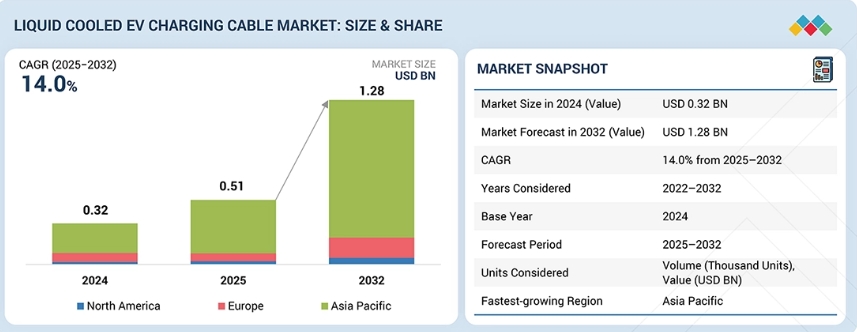
The Liquid Cooled EV Charging Cable Market is projected to grow from USD 0.51 billion in 2025and to reach USD 1.28 billion by 2032 at a Compound Annual Growth Rate (CAGR) of 14.0% during the forecast period.
The liquid cooled EV charging cable market is progressing as vehicle manufacturers increasingly adopt 800 V electrical architectures. These high-voltage systems are supporting faster charging while placing greater demands on current handling and thermal control within cable assemblies. Charging infrastructure operators are therefore favoring cable solutions that can support repeated high-power charging cycles without affecting safety or ease of use. Liquid cooling is enabling smaller and more manageable cable designs while maintaining thermal stability at elevated load levels. At the same time, growing standardization across charging platforms is easing regional deployment, while enhanced flexibility and ergonomics are encouraging wider use across public and commercial charging sites.
By cable power capacity, the 500–900 kW segment is projected to account for the largest segment during the forecast period.
The 500–900 kW segment is projected to be the largest segment during the forecast period, as these cables align closely with current ultrafast charging deployment needs while remaining technically and economically practical for most charging operators. These cables are widely used in 350 kW and above DC fast chargers, where thermal loads exceed the limits of air-cooled systems. High adoption of ultrafast DC chargers is driving sustained demand for liquid cooled cables in the 500–900 kW range, as operators are prioritizing charging sessions below 20 minutes without compromising cable handling and safety. The rising deployment of high-voltage vehicle platforms is increasing current density requirements, pushing cable manufacturers and charger OEMs toward liquid cooled designs optimized for this power band.
Download PDF Brochure @ https://www.marketsandmarkets.com/pdfdownloadNew.asp?id=263790047
By cable diameter, the 30–50 mm segment is projected to account for the largest share during the forecast period.
The 30–50 mm segment is projected to account for the largest share in the liquid cooled EV charging cable market during the forecast period. Cables in this diameter range offer balancing power-handling capability, thermal performance, flexibility, and installation practicality for ultrafast and megawatt-class DC charging systems. This diameter range supports high current transmission required for chargers with a power capacity of 350 kW and above, while maintaining manageable cable weight and bend radius. Additionally, the growing focus on user ergonomics at public charging stations is favoring cable diameters that limit weight and stiffness, especially for passenger vehicle and light commercial vehicle charging. Moreover, standardization efforts by charger OEMs and connector system providers are converging on this diameter range to ensure compatibility with CCS and emerging megawatt charging architectures. Cost optimization at the charging station level is driving preference for diameters that avoid excessive copper usage while still meeting thermal and electrical safety requirements.
In North America, the liquid cooled EV charging cable market is growing due to a rise in electric vehicle registrations, EV fleet expansion, and increasing demand for fast charging infrastructure that supports high power levels. Liquid cooling allows cables to handle high currents safely and reduces charging time for EV drivers. Additionally, federal and state initiatives are directing funding toward ultrafast DC chargers. Programs such as the National Electric Vehicle Infrastructure (NEVI) Formula Program have allocated significant capital to build high-power corridors. Liquid-cooled cables are necessary for sustained performance at these power levels. The US Inflation Reduction Act and related investments support the deployment of advanced EV infrastructure. Grants and tax incentives reduce the economic barriers for network operators to deploy liquid-cooled solutions at premium sites. Liquid cooling mitigates heat more effectively than air-cooled systems, enabling cables to operate at higher currents with lower thermal stress. This improves reliability and reduces maintenance costs for operators in diverse climates across the region.
Boyd, in collaboration with E-valucon, developed a liquid-to-air cooling system for DC fast charging cables and connectors suitable for North America and Europe. The system uses environmentally friendly coolants and supports safer high-power operation.
Key Players
The liquid cooled EV charging cable market is dominated by global players such as Phoenix Contact (Germany), HUBER+SUHNER (Switzerland), BRUGG eConnect (Switzerland), Sinbon Electronics Co., Ltd. (Taiwan), and LEONI (Germany). These companies have adopted strategies, such as product launches, strategic deals, and geographic expansions, to strengthen their market presence and technological capabilities.
Request Free Sample Report @ https://www.marketsandmarkets.com/requestsampleNew.asp?id=263790047
Media Contact
Company Name: MarketsandMarkets™ Research Private Ltd.
Contact Person: Mr. Rohan Salgarkar
Email: Send Email
Phone: 18886006441
Address:1615 South Congress Ave. Suite 103, Delray Beach, FL 33445
City: Florida
State: Florida
Country: United States
Website: https://www.marketsandmarkets.com/Market-Reports/liquid-cooled-ev-charging-cable-market-263790047.html
Press Release Distributed by ABNewswire.com
To view the original version on ABNewswire visit: Liquid Cooled EV Charging Cable Market worth USD 1.28 billion by 2032
Information contained on this page is provided by an independent third-party content provider. XPRMedia and this Site make no warranties or representations in connection therewith. If you are affiliated with this page and would like it removed please contact [email protected]
