
Global Personal Protective Equipment Market to Reach USD 76.9 Billion by 2036 | Future Market Insights, Inc.
Regulatory Tightening, Smart Safety Gear, and Industrial Modernization Redefine Global Worker Protection
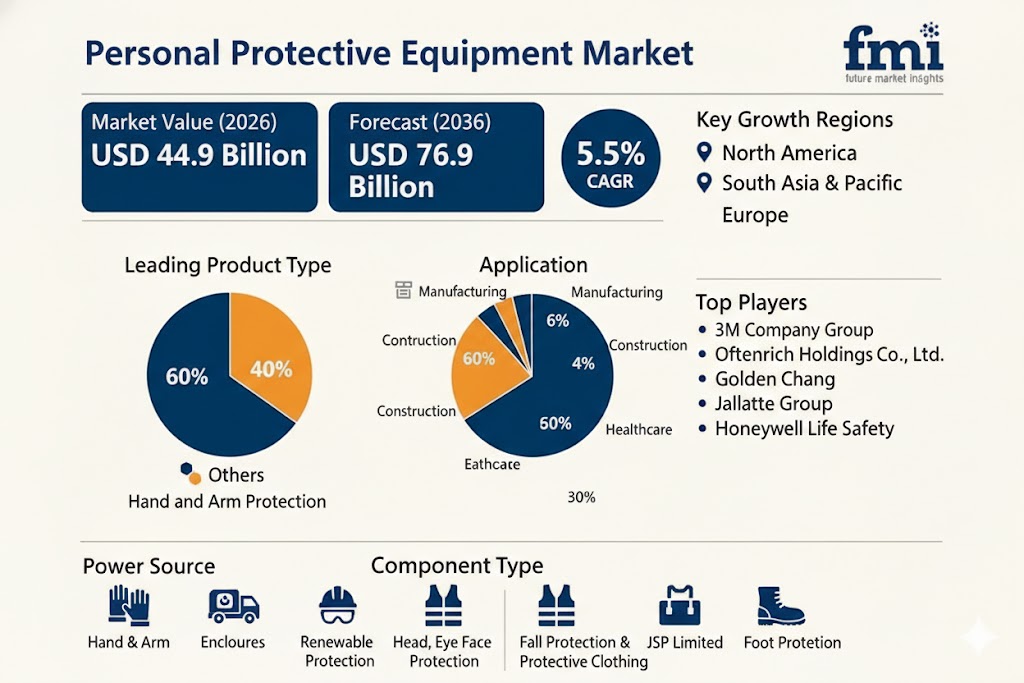
NEWARK, DE / ACCESS Newswire / February 9, 2026 / The global Personal Protective Equipment (PPE) market is entering a structurally resilient growth phase as workplace safety shifts from regulatory obligation to strategic priority. Valued at USD 44.9 billion in 2026, the market is forecast to reach USD 76.9 billion by 2036, expanding at a CAGR of 5.5%. Growth is underpinned by stricter occupational safety regulations, rising industrial activity, and sustained investment in worker health across high-risk environments.
According to recent industry analysis, PPE demand is no longer cyclical or event-driven. Instead, it is increasingly embedded into long-term operational planning across construction, manufacturing, oil & gas, mining, healthcare, and energy sectors. Organizations are prioritizing certified, high-performance protective solutions to reduce accident rates, limit downtime, and align with evolving compliance frameworks.
Safety as a Strategic Business Imperative
Personal Protective Equipment (PPE) has transitioned from a regulatory necessity to a strategic investment within enterprise risk management frameworks. Organizations increasingly recognize safety as a driver of workforce continuity, operational resilience, and ESG compliance. Strengthening safety culture not only minimizes workplace incidents but also improves productivity, lowers insurance liabilities, and supports long-term sustainability goals across industries.
Key Points:
PPE integrated into enterprise risk and ESG strategies
Reduced downtime and insurance exposure
Safety culture linked to productivity and retention
Growing executive-level focus on worker protection
Broad-Based Industrial Demand Sustains Market Growth
Rising awareness of occupational hazards across industrial and institutional environments is fueling steady PPE adoption. Demand spans gloves, protective apparel, helmets, respiratory protection, and eye and face gear. High-risk sectors such as manufacturing, construction, and petrochemicals continue to rely on PPE to mitigate mechanical, chemical, and thermal hazards, ensuring consistent, volume-driven consumption.
Key Points:
Strong demand from manufacturing and construction
High usage in chemically and thermally intensive operations
Wide adoption across industrial and institutional settings
PPE demand increasingly standardized, not discretionary
Healthcare Dominates PPE Consumption Globally
Healthcare remains the largest end-use segment, accounting for approximately 36% of global PPE demand in 2026. Persistent infection-control protocols, rising surgical and diagnostic procedures, and preparedness for biological threats have made PPE a recurring operational requirement. Unlike project-based industrial use, healthcare PPE consumption is continuous, reinforcing long-term market stability.
Key Points:
Healthcare leads global PPE demand share
Continuous infection prevention requirements
Rising patient volumes and procedures
Long-term demand supported by biohazard preparedness
Product Leadership: Hand and Arm Protection Dominates
Among product categories, hand and arm protection leads the global PPE market, representing 27% of total demand in 2026. Gloves and sleeves remain indispensable across healthcare, manufacturing, construction, and chemical processing due to the prevalence of direct contact hazards.
Material innovation is reinforcing this dominance, with manufacturers introducing:
Cut-resistant and puncture-resistant fibers
Chemical- and heat-resistant coatings
Ergonomic designs that reduce fatigue during extended wear
While respiratory and eye protection continue to gain importance, hand protection remains the most frequently replaced and universally required PPE category across industries.
Technology and Design: Smarter, Lighter, More Wearable
Technological advancement is reshaping PPE from basic protective gear into intelligent safety equipment. Smart PPE embedded with sensors for heat stress, toxic exposure, and location tracking is gaining traction, particularly in construction, energy, and mining environments. These connected solutions enable real-time monitoring and proactive incident prevention.
At the same time, manufacturers are focusing on comfort-driven innovation. Lightweight composites, breathable fabrics, and ergonomic designs are improving wearer compliance, addressing one of the industry's longstanding challenges. Improved usability directly supports higher adoption rates and more consistent protection outcomes.
Regional Outlook: Emerging Economies Accelerate Adoption
Demand growth is particularly strong in emerging economies where industrialization, infrastructure development, and regulatory tightening are converging. Asia-Pacific, East Asia, and South Asia & Pacific are witnessing rapid expansion as millions of workers enter regulated industrial environments.
In developed markets, replacement demand and premiumization dominate:
United States (5.0% CAGR): Driven by stricter OSHA enforcement, healthcare expansion, and adoption of smart PPE
Japan (4.8% CAGR): Focused on ergonomic, heat-resistant designs aligned with an aging workforce
France (4.6% CAGR) & Germany (4.5% CAGR): Anchored in EU compliance, sustainability goals, and industrial modernization
United Kingdom (3.7% CAGR): Supported by infrastructure investment and public-sector procurement
Market Snapshot: Personal Protective Equipment Industry
Metric | Value (2026-2036) |
|---|---|
Market Value (2026) | USD 44.9 Billion |
Forecast Value (2036) | USD 76.9 Billion |
Projected CAGR | 5.5% |
Leading Product Type | Hand & Arm Protection |
Largest End Use | Healthcare (36%) |
Key Growth Regions | North America, East Asia, South Asia & Pacific |
Market Challenges: Cost Volatility and Counterfeit Risks
Despite strong demand fundamentals, the PPE market continues to face structural challenges. Fluctuating prices of polymers, rubber, and technical textiles are compressing manufacturer margins, particularly for cost-sensitive product categories. Additionally, the proliferation of counterfeit and low-quality PPE undermines worker safety and erodes trust, especially in emerging markets with uneven enforcement. Regulatory fragmentation across regions further increases compliance costs and delays product launches. However, tighter enforcement, digital traceability, and growing buyer focus on total cost of ownership are gradually easing these pressures.
Key Challenge Drivers
Volatile raw material pricing affecting profitability
Counterfeit and substandard PPE impacting safety outcomes
Complex, multi-country certification requirements
Longer time-to-market due to regulatory diversity
Competitive Landscape: Innovation, Trust, and Lifecycle Value
Competition in the PPE market is intensifying as buyers prioritize certified performance, reliability, and long-term value. Global leaders such as 3M Company, Honeywell Life Safety, and Ansell Healthcare Products leverage broad portfolios, deep R&D capabilities, and strong industrial relationships to maintain leadership. These players are increasingly investing in connected safety solutions, next-generation respiratory protection, and advanced chemical-resistant materials. Meanwhile, regional and mid-sized manufacturers are gaining traction through localized product design, faster customization, and strong regulatory alignment, positioning themselves as agile and cost-effective alternatives.
Competitive Success Factors
Investment in advanced and connected PPE technologies
Strong certification and compliance track records
Customization and localized product offerings
End-to-end lifecycle support and service reliability
Outlook to 2036: PPE as a Permanent Safety Infrastructure
By 2036, personal protective equipment will be viewed less as consumable gear and more as an integrated safety infrastructure. As industries modernize and workforce protection becomes inseparable from productivity and compliance, PPE demand will remain structurally strong.
The market's future will be shaped by smart technology integration, sustainable materials, and global alignment around safer working environments-positioning PPE as a foundational investment in modern industrial operations.
For an in-depth analysis of evolving formulation trends and to access the complete strategic outlook for the Personal Protective Equipment Market through 2035, Full Report Request: https://www.futuremarketinsights.com/reports/personal-protective-equipment-market
Related Reports:
Ballistic Protective Equipment Market- https://www.futuremarketinsights.com/reports/ballistic-protective-equipment-market
Respiratory Protective Equipment Market- https://www.futuremarketinsights.com/reports/respiratory-protective-equipment-market
Industrial Power Monitoring System Market- http://futuremarketinsights.com/reports/industrial-power-monitoring-system-market
About Future Market Insights (FMI)
Future Market Insights (FMI) is a leading provider of market intelligence and consulting services, serving clients in over 150 countries. Headquartered in Delaware, USA, with a global delivery center in India and offices in the UK and UAE, FMI delivers actionable insights to businesses across industries including automotive, technology, consumer products, manufacturing, energy, and chemicals.
An ESOMAR-certified research organization, FMI provides custom and syndicated market reports and consulting services, supporting both Fortune 1,000 companies and SMEs. Its team of 300+ experienced analysts ensures credible, data-driven insights to help clients navigate global markets and identify growth opportunities.
For Press & Corporate Inquiries
Rahul Singh
AVP - Marketing and Growth Strategy
Future Market Insights, Inc.
+91 8600020075
For Sales - [email protected]
For Media - [email protected]
For web - https://www.futuremarketinsights.com/
SOURCE: Future Market Insights, Inc.
Information contained on this page is provided by an independent third-party content provider. XPRMedia and this Site make no warranties or representations in connection therewith. If you are affiliated with this page and would like it removed please contact [email protected]
