
Hydrolyzed Vegetable Protein Market to Reach USD 3.1 Billion by 2036, Amid Rising Demand for Savory Processed Foods and Plant-Based Platforms
The Hydrolyzed Vegetable Protein Market is expanding steadily, driven by tighter supplier governance, compliance-focused procurement, and rising demand for consistent savory ingredient performance.
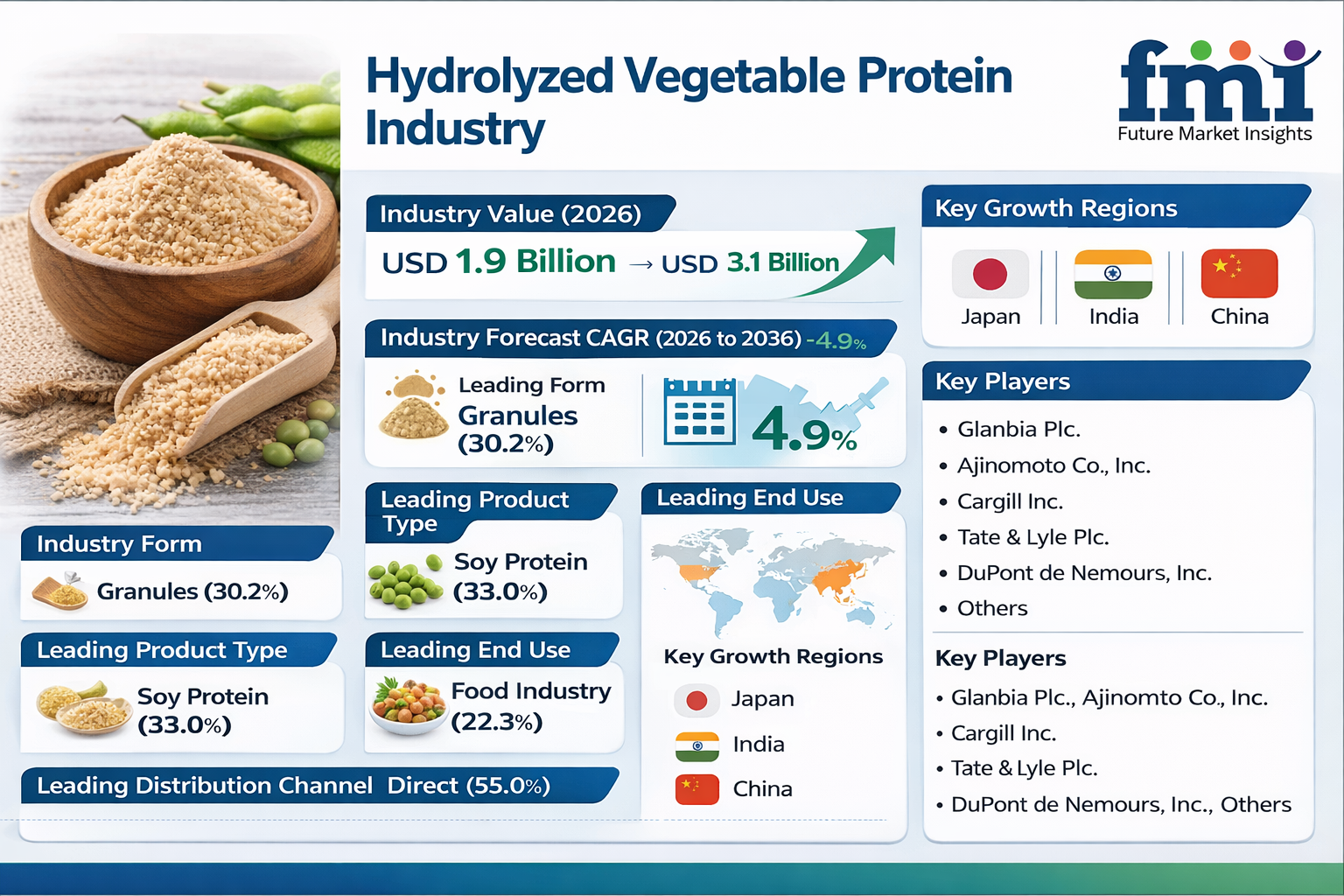
NEWARK, DELAWARE / ACCESS Newswire / February 12, 2026 / The Hydrolyzed Vegetable Protein Market is projected to grow from USD 1.9 Billion in 2026 to USD 3.1 Billion by 2036, expanding at a 4.9% CAGR. Growth is being shaped by tighter supplier governance, documentation rigor, and demand for repeatable sensory outcomes across large-scale savory manufacturing. As compliance, labeling, and allergen transparency become central to procurement strategies, the Hydrolyzed Vegetable Protein Market is evolving into a specification-driven, contract-led landscape.
Market snapshot: Global Hydrolyzed Vegetable Protein Market 2026 - 2036
Market size in 2026? USD 1.9 Billion.
Market size in 2036? USD 3.1 Billion.
CAGR (2026-2036)? 4.9%.
Leading form segment? Granules - 30.2% share.
Leading product type? Soy Protein - 33.0% share.
Leading end use? Food Industry - 22.3% share.
Leading distribution channel? Direct - 55.0% share.
Key growth regions? Japan, India, China.
Top companies? Glanbia Plc., Ajinomoto Co., Inc., Cargill Inc., Tate & Lyle Plc., DuPont de Nemours, Inc., Puris Proteins LLC, Fuji Oil Holdings, Inc., The Scoular Company, Innova Flavors, Axiom Foods, Inc., Wilmar International Limited, Burcon NutraScience Corporation, AMCO Proteins.
Market Momentum (2026-2036 Path)
The Hydrolyzed Vegetable Protein Market stands at USD 1.9 Billion in 2026 and is forecast to reach USD 3.1 Billion by 2036, advancing at a steady 4.9% CAGR. Expansion through 2028 and 2030 reflects structured supplier qualification and stronger direct contracting models. By 2031 and 2033, growth momentum is reinforced by compliance-led renovation cycles and tighter change-control thresholds. Entering 2035 and ultimately 2036, the market outlook remains anchored in disciplined procurement architectures designed to protect taste consistency, labeling defensibility, and audit readiness across global savory portfolios.
Why the Market is Growing
The Hydrolyzed Vegetable Protein Market is expanding alongside the continued scale-up of savory processed foods, seasoning systems, and convenience formats. Manufacturers are prioritizing consistent taste delivery and stable manufacturing execution, particularly where reformulation risk can disrupt national or multi-country rollouts.
Buying programs are increasingly structured around protecting repeatability and minimizing reformulation events. Ingredient system planning is also closely coordinated with broader taste-direction strategies linked to food flavor enhancers and umami reinforcement. Alignment with natural savory profiles associated with yeast extracts further supports adoption, especially under clean label and allergen-sensitive frameworks.
Segment Spotlight
1) By Form: Granules Lead with 30.2%
Granules account for 30.2% of the Hydrolyzed Vegetable Protein Market by form. Their dominance reflects alignment with controlled dosing, stable handling, and repeatable manufacturing execution in high-throughput operations. Where process windows are narrow and deviations translate into rework or taste drift, granules offer predictable blending performance across multiple plants.
2) By Product Type: Soy Protein at 33.0%
Soy Protein holds a 33.0% share, supported by established procurement programs and longer qualification histories within savory manufacturing ecosystems. Buyers favor supply structures offering consistent specifications, validated quality systems, and dependable technical support. Switching frequency remains limited where downstream approvals are tightly controlled and revalidation cycles are costly.
3) By End Use: Food Industry at 22.3%
The Food Industry represents 22.3% of demand in the Hydrolyzed Vegetable Protein Market. Hydrolyzed inputs remain embedded in scaled savory manufacturing where taste consistency and process robustness drive decision-making. Renovation cycles across geographies reinforce demand for stable sensory baselines and predictable ingredient performance.
4) By Distribution Channel: Direct at 55.0%
Direct distribution leads with a 55.0% share. Buyers rely on direct relationships to protect supply continuity, specification stability, and change-control visibility. Audit expectations and faster corrective-action requirements further sustain direct supply leadership.
Drivers, Opportunities, Trends, Challenges
Drivers:
Demand is driven by the expansion of savory processed foods and seasoning systems requiring consistent taste reinforcement and processing resilience. Predictable outcomes under cost pressure remain a central procurement objective.
Opportunities:
Plant-based platform expansion across meat substitutes and hybrid products creates new avenues for hydrolyzed inputs. Manufacturers evaluating plant based protein and meat substitutes frameworks increasingly integrate hydrolyzed vegetable proteins into broader ingredient stacks.
Trends:
Governance is tightening through narrower specification tolerances, stronger audit expectations, and explicit change-notification thresholds. Direct contracting models are strengthening as traceability and corrective-action speed become strategic priorities.
Challenges:
Qualification processes are becoming more documentation-heavy, with heightened allergen disclosure requirements and labeling defensibility built into supplier scorecards. Managing raw material variability while sustaining sensory consistency across geographies remains a structural challenge.
Country Growth Outlook (CAGR 2026-2036)
Country | CAGR |
USA | 6.4% |
UK | 6.7% |
China | 7.1% |
India | 7.6% |
Japan | 8.3% |
Japan leads growth at 8.3% CAGR, supported by structured labeling standards and disciplined food information management. India (7.6%) and China (7.1%) benefit from labeling governance, seasoning production scale, and localized savory manufacturing expansion. The UK (6.7%) reflects allergen transparency emphasis, while the USA (6.4%) aligns procurement discipline with gluten-free claim compliance frameworks.
Competitive Landscape
Competition in the Hydrolyzed Vegetable Protein Market is defined by quality system maturity, specification control, and the ability to deliver consistent performance across applications. Suppliers demonstrating disciplined documentation, reliable supply continuity, and responsive technical support are positioned to secure long-cycle contracts.
Key Players in Hydrolyzed Vegetable Protein Market
Glanbia Plc.
Ajinomoto Co., Inc.
Cargill Inc.
Tate & Lyle Plc.
DuPont de Nemours, Inc.
Puris Proteins LLC
Fuji Oil Holdings, Inc.
The Scoular Company
Innova Flavors
Axiom Foods, Inc.
Wilmar International Limited
Burcon NutraScience Corporation
AMCO Proteins
For an in-depth analysis of evolving formulation trends and to access the complete strategic outlook for the Hydrolyzed Vegetable Protein Market through 2036, visit the official report page at: https://www.futuremarketinsights.com/reports/hydrolysed-vegetable-protein-market
Related Reports:
Hydrolyzed Vegetable Protein Market Share Analysis: https://www.futuremarketinsights.com/reports/hydrolyzed-vegetable-protein-market-share-analysis
UK Hydrolyzed Vegetable Protein Market: https://www.futuremarketinsights.com/reports/united-kingdom-hydrolyzed-vegetable-protein-market
USA Hydrolyzed Vegetable Protein Market: https://www.futuremarketinsights.com/reports/united-states-hydrolyzed-vegetable-protein-market
Hydrolyzed Oat Protein Market: https://www.futuremarketinsights.com/reports/hydrolyzed-oat-protein-market
Hydrolyzed Corn Protein Market: https://www.futuremarketinsights.com/reports/hydrolyzed-corn-protein-market
About Future Market Insights (FMI)
Future Market Insights (FMI) is a leading provider of market intelligence and consulting services, serving clients in over 150 countries. Headquartered in Delaware, USA, with a global delivery center in India and offices in the UK and UAE, FMI delivers actionable insights to businesses across industries including automotive, technology, consumer products, manufacturing, energy, and chemicals.
An ESOMAR-certified research organization, FMI provides custom and syndicated market reports and consulting services, supporting both Fortune 1,000 companies and SMEs. Its team of 300+ experienced analysts ensures credible, data-driven insights to help clients navigate global markets and identify growth opportunities.
For Press & Corporate Inquiries
Rahul Singh
AVP - Marketing and Growth Strategy
Future Market Insights, Inc.
+91 8600020075
For Sales - [email protected]
For Media - [email protected]
For web - https://www.futuremarketinsights.com/
SOURCE: Future Market Insights, Inc.
Information contained on this page is provided by an independent third-party content provider. XPRMedia and this Site make no warranties or representations in connection therewith. If you are affiliated with this page and would like it removed please contact [email protected]
