
Alzheimer's Therapeutics Market to Reach USD 10.4 Billion by 2036 as Disease-Modifying Immunotherapies Transform Treatment Paradigms
We are truly in a new era. We have opened the door to understanding and manipulating the biology of Alzheimer's disease for the benefit of our patients,"
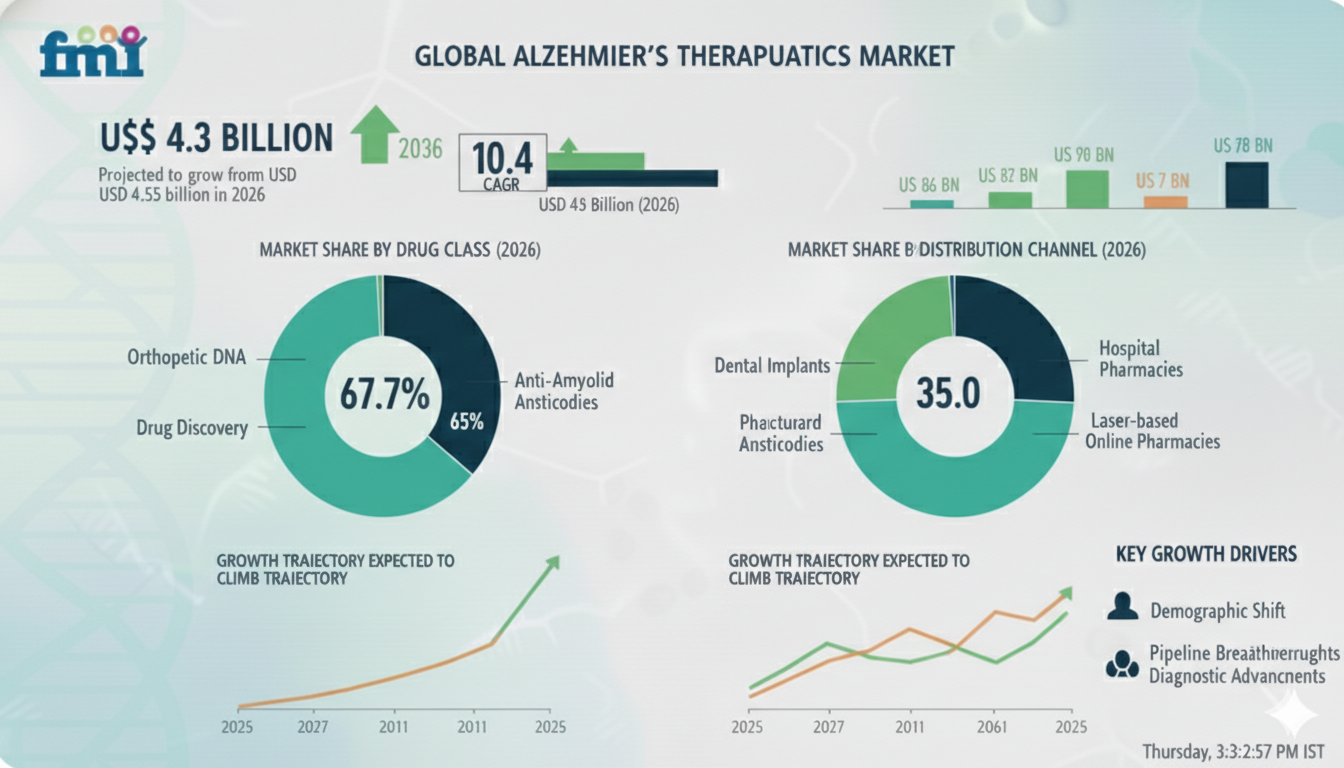
NEWARK, DE / ACCESS Newswire / February 12, 2026 / The global Alzheimer's therapeutics market is entering a historic transformation phase. Valued at USD 4.3 billion in 2026, the market is projected to more than double to USD 10.4 billion by 2036, expanding at a robust CAGR of 9.3%. This growth is being fueled by a paradigm shift from purely symptomatic management toward disease-modifying immunotherapies that directly target the biological drivers of Alzheimer's disease.
According to a comprehensive strategic outlook from Future Market Insights (FMI), recent FDA approvals of anti-amyloid therapies such as lecanemab and donanemab have fundamentally reshaped the clinical landscape, marking the first credible pathway to slowing disease progression rather than simply managing cognitive decline. This shift is unlocking a new era of therapeutic innovation, infrastructure investment, and value-based care models across global healthcare systems.
From Symptom Control to Disease Modification: A Structural Shift
The industry is undergoing a structural realignment as traditional cholinesterase inhibitors, led by Donepezil, continue to dominate treatment volume, while high-cost biologics drive disproportionate value growth. FMI identifies this as a "dual-engine market," where legacy oral therapies ensure broad patient coverage, while infusion-based immunotherapies redefine revenue dynamics.
"We are truly in a new era. We have opened the door to understanding and manipulating the biology of Alzheimer's disease for the benefit of our patients," notes Jeff Cummings, Professor of Brain Science, University of Nevada.
This evolution is accelerating investments in diagnostic screening, biomarker testing, and infusion center capacity, as healthcare systems prepare to support a new standard of care centered on early intervention and biologic administration.
Infrastructure and Economics: Hospitals Become the Central Hub
The rise of infusion-based therapies is shifting distribution power toward hospital pharmacies, which now command 35.0% of total market share. These facilities are uniquely equipped to manage complex biologics, MRI monitoring, and safety protocols for adverse effects such as ARIA (Amyloid-Related Imaging Abnormalities).
The economic burden of Alzheimer's disease is further intensifying this shift. In the United States alone, total dementia care costs are projected to reach USD 384 billion in 2025, with Medicare and Medicaid accounting for USD 246 billion. As payers demand stronger health-economic evidence, pharmaceutical companies must now demonstrate not only clinical efficacy, but also the ability to reduce long-term institutionalization and overall system costs.
Segment Spotlight: Donepezil and the Rise of Biologics
Donepezil (67.7% Share): Retains dominance due to low cost, oral availability, and first-line status across all disease stages, ensuring continued relevance for symptom management.
Amyloid Immunotherapies: While lower in volume, these therapies are driving the majority of value growth, reshaping pricing, reimbursement, and care delivery models.
Hospital Pharmacies (35.0% Share): Strengthening their leadership as the primary channel for high-value, infusion-based treatments.
Regional Powerhouses: Asia and Emerging Markets Accelerate
While North America and Europe remain high-value markets, the fastest growth is occurring in Asia, where aging populations and evolving healthcare infrastructure are rapidly expanding access:
Japan (12% CAGR): A super-aged society and supportive regulatory environment are positioning Japan as a global testbed for advanced Alzheimer's care.
India (11.6% CAGR): Growth is driven by expanding hospital networks, rising awareness, and demand for scalable, cost-effective therapies.
United States (9% CAGR): A mature but dynamic market where innovation is colliding with reimbursement reform and massive patient volumes.
Market Metrics at a Glance (2026-2036)
Market Metric | Value / Detail |
|---|---|
Current Market Value (2026) | USD 4.3 Billion |
Projected Market Value (2036) | USD 10.4 Billion |
Global Growth Rate (CAGR) | 9.3% |
Leading Drug | Donepezil (67.7%) |
Leading Distribution Channel | Hospital Pharmacies (35.0%) |
Top Growth Markets | Japan (12%), India (11.6%) |
Dynamics of the Decade: Biomarkers, Multi-Mechanism Therapies, and Value-Based Care
Looking ahead to 2036, FMI identifies several forces set to redefine competitive advantage:
Blood-Based Diagnostic Revolution: Highly accurate blood biomarker tests (85-90% accuracy) are democratizing early diagnosis and expanding the pool of treatable patients.
Multi-Mechanism Synergies: Combination therapies targeting amyloid, tau, inflammation, and metabolic dysfunction are emerging as the next frontier.
Value-Driven Reimbursement: Payers are increasingly linking reimbursement to demonstrated reductions in long-term care costs and institutionalization rates.
"But just over the last five or so years, we've hit an inflection point. We're starting to get traction," says Martin Kampmann, Professor at UCSF, highlighting the momentum behind next-generation Alzheimer's therapies.
Competitive Landscape
The market is defined by an intensifying race to dominate the disease-modifying segment while defending legacy symptomatic franchises. Tier-1 pharmaceutical players are increasing R&D reinvestment, often allocating 20-25% of revenue to neurodegenerative pipelines, while M&A activity accelerates to secure novel mechanisms of action.
Key Players in the Alzheimer's Therapeutics Market:
Eisai Co. Ltd., Novartis AG, AbbVie, Biogen, Eli Lilly and Company, Aurobindo Pharma Ltd., Johnson & Johnson, Dr. Reddy's Laboratories Ltd., Viatris, F. Hoffmann-La Roche Ltd.
For an in-depth analysis of evolving therapeutic strategies, biomarker integration, and regional growth opportunities, access the complete strategic outlook for the Alzheimer's Therapeutics Market through 2036 at: https://www.futuremarketinsights.com/reports/alzheimers-therapeutics-market
Related Reports:
COPD Therapeutics Market: https://www.futuremarketinsights.com/reports/chronic-obstructive-pulmonary-disease-therapeutics-market
Digital Therapeutics Market: https://www.futuremarketinsights.com/reports/digital-therapeutics-market
Peptide Therapeutics Market: https://www.futuremarketinsights.com/reports/peptide-therapeutics-market
Glaucoma Therapeutics Market: https://www.futuremarketinsights.com/reports/glaucoma-therapeutics-market
Pet Cancer Therapeutics Market: https://www.futuremarketinsights.com/reports/pet-cancer-therapeutics-market
About Future Market Insights (FMI)
Future Market Insights (FMI) is a leading provider of market intelligence and consulting services, serving clients in over 150 countries. Headquartered in Delaware, USA, with a global delivery center in India and offices in the UK and UAE, FMI delivers actionable insights to businesses across industries including automotive, technology, healthcare, consumer products, manufacturing, energy, and chemicals.
An ESOMAR-certified research organization, FMI provides custom and syndicated market reports and consulting services, supporting both Fortune 1,000 companies and SMEs. Its team of 300+ experienced analysts ensures credible, data-driven insights to help clients navigate global markets and identify growth opportunities.
For Press & Corporate Inquiries
Rahul Singh
AVP - Marketing and Growth Strategy
Future Market Insights, Inc.
+91 8600020075
For Sales - [email protected]
For Media - [email protected]
For web - https://www.futuremarketinsights.com
SOURCE: Future Market Insights, Inc.
Information contained on this page is provided by an independent third-party content provider. XPRMedia and this Site make no warranties or representations in connection therewith. If you are affiliated with this page and would like it removed please contact [email protected]
