
Global Fertility Supplement Market to Reach USD 2.8 Billion by 2036 as Regimen Reliability and Trust Signaling Strengthen Consumer Retention
Fertility supplement demand is rising as consumers adopt preventive healthcare, personalized nutrition, and routine-based wellness supported by trust and quality.
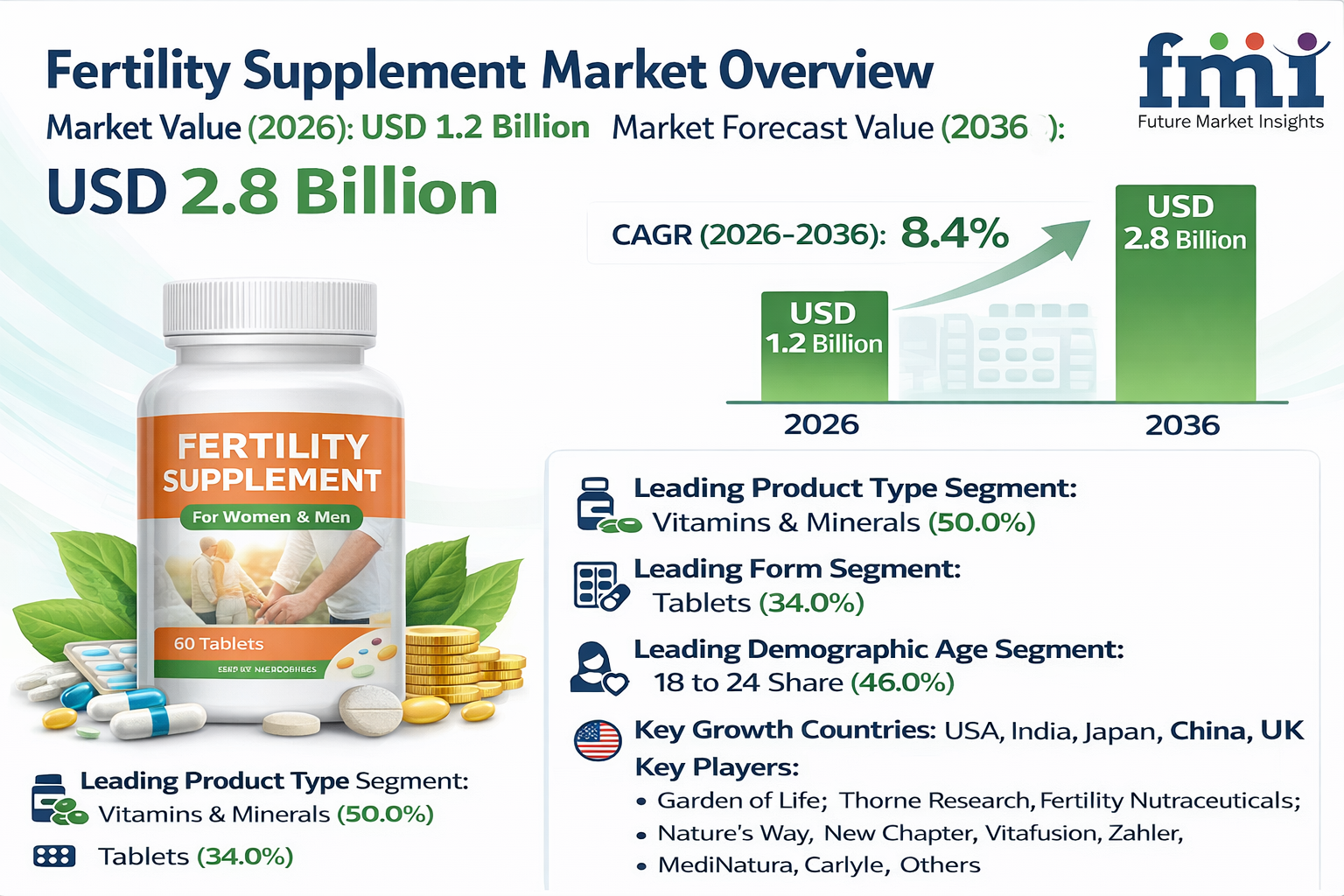
NEWARK, DELAWARE / ACCESS Newswire / February 13, 2026 / The global fertility supplement market is entering a decade of structured expansion, projected to grow from USD 1.2 billion in 2026 to USD 2.8 billion by 2036, according to the latest analysis by Future Market Insights (FMI). This trajectory reflects a robust CAGR of 8.4%, supported by rising comfort in self-directed nutrition decisions and increasing routine-based wellness behavior.
Growth formation in this category is increasingly shaped by how confidently consumers can navigate product selection, timing, and regimen continuity in a crowded supplement environment. Demand strengthens where brands reduce perceived trial risk through simplified dosing structures, clearer ingredient logic, and consistent quality signaling.
Regimen Reliability: The New Growth Engine
FMI analysis indicates that value creation is shifting from single-product selling toward regimen reliability. Brands that defend repeat purchase through:
Consistent supply discipline
Stable sensory performance
Credible formulation positioning
Clear duration and usage guidance
are better positioned to convert initial interest into sustained monthly usage.
This dynamic is particularly visible among younger cohorts, where experimentation rates are high but churn increases when results feel ambiguous or routines become difficult to maintain. As a result, subscription-enabled replenishment and structured daily compliance systems are becoming central competitive levers.
Segment Leadership: Foundational Formats Drive Scale
The fertility supplement category is segmented by product type, form, and demographic age, reflecting both efficacy perception and routine sustainability.
By Product Type: Vitamins and Minerals Lead with 50.0% Share
Vitamins and minerals dominate the market, holding a 50.0% share. Their leadership stems from ease of consumer understanding and positioning as foundational nutritional support rather than niche intervention. These products are frequently framed around ingredient familiarity and sourcing discipline, strengthening repeat purchase confidence.
By Form: Tablets Hold 34.0% Share
Tablets account for 34.0% of the market due to cost efficiency, stable shelf performance, and simplified daily adherence. Their compatibility with subscription workflows and monthly replenishment models reinforces continuity in routine-based consumption patterns.
By Demographic Age: 18-24 Cohort Commands 46.0% Share
The 18 to 24 age group leads with a 46.0% share. Higher experimentation rates, digital commerce exposure, and habit-building behavior contribute to this dominance. Engagement is often supported by structured reminders and tracking tools that strengthen regimen adherence.
Key Industry Insights Shaping Expansion
Development | Desired Impact |
Personalization Engines in Wellness Commerce | Improves conversion by translating consumer intent into structured regimen pathways, reducing confusion in ingredient-heavy assortments. |
Third-Party Quality Signaling | Shifts competition toward traceability, batch discipline, and measurable consistency claims. |
D2C Replenishment Models | Protects regimen cadence, reduces stockouts, and increases lifetime value. |
Compliance-Optimized Packaging | Minimizes missed doses through organized daily formats and travel-friendly designs. |
Drivers, Restraints, and Opportunities
Primary Drivers
Shift from one-time purchases to routine-based nutrition
Greater comfort in self-directed fertility wellness decisions
Rising demand for clean-label and transparent formulations
Subscription adoption that reduces churn
A central driver is regimen anchoring through clearer use cases and simplified compliance. Brands that reduce ambiguity around when to take supplements, how long to stay on regimen, and expected outcomes are improving retention metrics.
Key Restraints
Rising skepticism toward broad or exaggerated claims
Longer evaluation cycles before purchase
Sensory trade-offs in certain active ingredients
Cart abandonment linked to trust gaps
Emerging Opportunities
Life-stage pathway portfolios that connect preconception, pregnancy planning, and postpartum recovery
Subscription models stabilizing demand forecasting
Packaging innovation as a measurable conversion lever
Country-Level Growth Momentum
The fertility supplement landscape reflects strong performance across developed and emerging markets.
Country | CAGR (2026-2036) |
USA | 8.8% |
India | 8.7% |
Japan | 8.5% |
China | 8.3% |
UK | 7.5% |
United States (8.8%)
Growth is supported by high D2C penetration and routine-oriented supplement usage. Subscription replenishment models protect regimen continuity and improve lifetime value.
India (8.7%)
Rapid expansion of online health commerce and affordability-focused purchasing behavior support adoption. Urban and tier-two clusters are increasingly adopting monthly replenishment routines once trust is established.
Japan (8.5%)
High expectations around quality discipline and strong familiarity with functional nutrition drive demand. Life-stage integration supports longer-duration use rather than short-term experimentation.
China (8.3%)
Active cross-border commerce and brand credibility narratives shape demand. Structured online recommendation flows improve conversion when regimen logic is clearly communicated.
United Kingdom (7.5%)
Pharmacy-linked credibility and life-stage planning frameworks support steady expansion, particularly where compliance-friendly routines are emphasized.
Competitive Outlook: Trust Conversion as a Differentiator
Competition is increasingly defined by the ability to convert trust into repeat purchase while minimizing regimen friction. Leading players are differentiating across three core execution pillars:
Portfolio clarity and structured regimen architecture
Operationalized clean-label and quality narratives
Packaging designed to improve dose discipline and reduce missed days
Execution strategies are often aligned with demand planning discipline and personalized fertility care pathways, where structured guidance improves consumer retention.
Key Players in Fertility Supplement Market
Garden of Life
Thorne Research
Fertility Nutraceuticals
Nature's Way
New Chapter
Vitafusion
Zahler
MediNatura
Carlyle
Others
Outlook Through 2036
As fertility-related nutrition becomes integrated into broader lifestyle and life-stage planning, the category is evolving from occasional purchase to sustained routine behavior. Brands that defend consistency, communicate disciplined formulation logic, and simplify daily compliance are expected to capture disproportionate share.
With subscription adoption, quality signaling, and structured regimen design shaping demand, the fertility supplement market is positioned for durable expansion through 2036.
For an in-depth analysis of evolving formulation trends and to access the complete strategic outlook for the Fertility Supplement Market through 2036, visit the official report page at: https://www.futuremarketinsights.com/reports/fertility-supplements-market
Explore More Related Studies Published by FMI Research:
Demand for Fertility Supplements in EU: https://www.futuremarketinsights.com/reports/demand-for-fertility-supplements-in-eu
Food Supplement Ingredients Market: https://www.futuremarketinsights.com/reports/food-supplement-ingredients-market
Vegan Supplements Market: https://www.futuremarketinsights.com/reports/vegan-supplements-market
Fiber Supplements Market: https://www.futuremarketinsights.com/reports/fiber-supplements-market
Energy Supplement Market: https://www.futuremarketinsights.com/reports/energy-supplement-market
About Future Market Insights (FMI)
Future Market Insights (FMI) is a leading provider of market intelligence and consulting services, serving clients in over 150 countries. Headquartered in Delaware, USA, with a global delivery center in India and offices in the UK and UAE, FMI delivers actionable insights to businesses across industries including automotive, technology, consumer products, manufacturing, energy, and chemicals.
An ESOMAR-certified research organization, FMI provides custom and syndicated market reports and consulting services, supporting both Fortune 1,000 companies and SMEs. Its team of 300+ experienced analysts ensures credible, data-driven insights to help clients navigate global markets and identify growth opportunities.
For Press & Corporate Inquiries
Rahul Singh
AVP - Marketing and Growth Strategy
Future Market Insights, Inc.
+91 8600020075
For Sales - [email protected]
For Media - [email protected]
For web - https://www.futuremarketinsights.com/
SOURCE: Future Market Insights, Inc.
Information contained on this page is provided by an independent third-party content provider. XPRMedia and this Site make no warranties or representations in connection therewith. If you are affiliated with this page and would like it removed please contact [email protected]
